
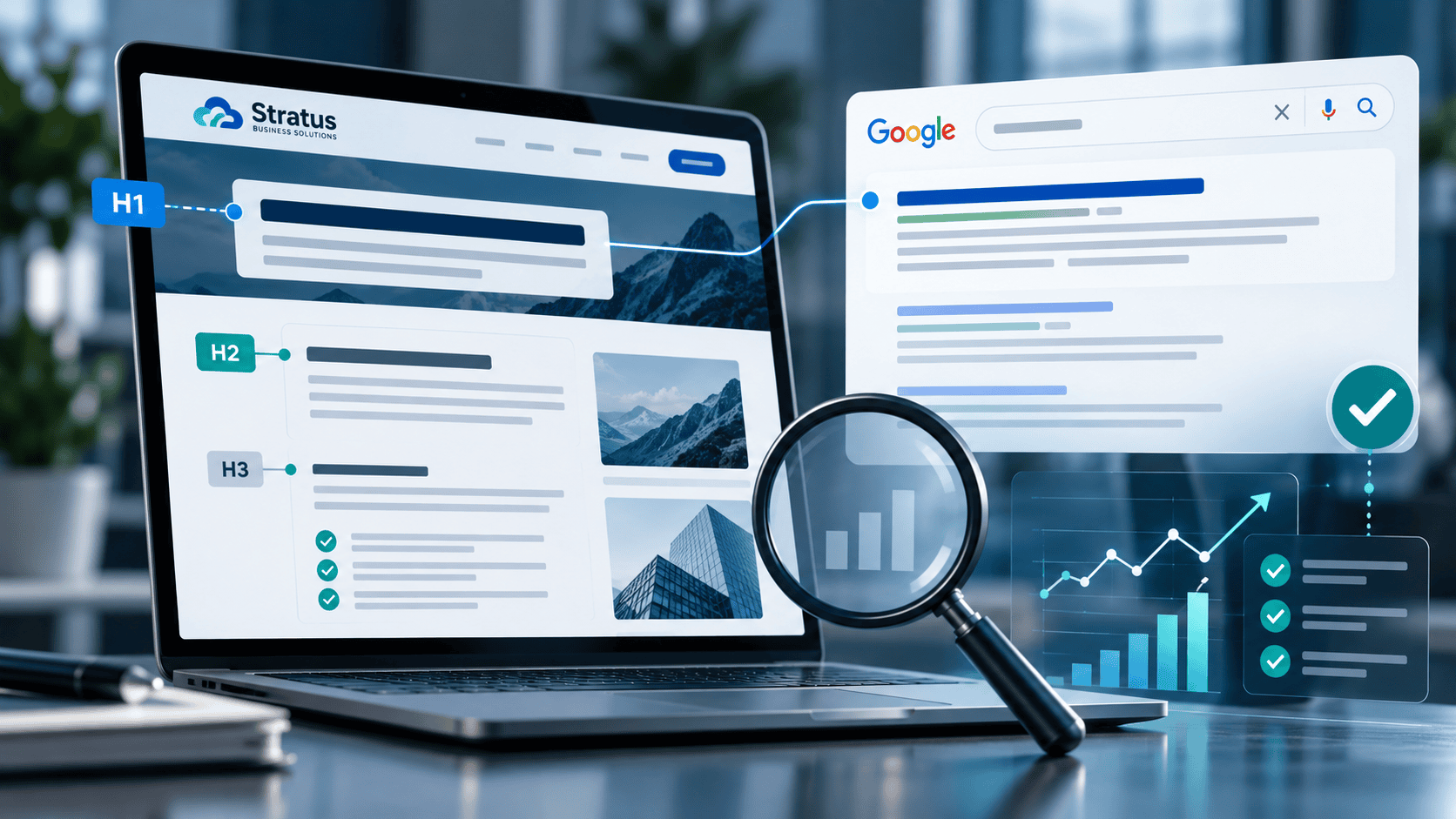

How properly structured headings help search engines understand your website, improve search relevance, and turn more visitors into customers.
When most business owners think about improving their website's search engine rankings, they focus on keywords, backlinks, page speed, and content. But one of the simplest and most frequently overlooked elements of effective SEO is sitting right at the top of nearly every webpage: the heading.
More specifically, the H1 heading.
A properly written H1 can help search engines understand what a page is about, reinforce its relevance to a visitor's search, and communicate the page's purpose immediately. Combined with well-organized supporting headings, it creates a stronger foundation for both search engine optimization and the visitor experience.
Let's explore why headings matter, how Google uses them, and what your business can do to make them more effective.
Table of Contents
- What Are Website Headings?
- Why the H1 Heading Is So Important
- How Google Uses H1 Headings in Search Results
- Headings and Search Intent Validation
- The Importance of Proper Heading Structure
- Common Heading Mistakes
- Best Practices for Better SEO
- The Bottom Line
What Are Website Headings?
Website headings are HTML elements used to organize the information on a webpage. They range from H1 through H6, with each level representing a different position in the content hierarchy.
Think of them as the outline of a well-organized document.
- H1: The main topic or primary title of the page.
- H2: Major sections supporting the main topic.
- H3: Subsections providing additional details.
- H4–H6: Further levels of organization for complex content.
For example, an office furniture dealer might have an H1 reading "Professional Office Furniture Solutions in Dallas," followed by H2 headings for "Office Desks," "Ergonomic Seating," and "Workspace Design Services."
This structure makes the page easier for visitors to navigate while helping search engines interpret its organization.
Importantly, headings are not simply large, bold text. They are meaningful HTML elements that communicate the relationships between different parts of a page.
Why the H1 Heading Is So Important
The H1 is generally the most important visible heading on a webpage because it identifies the page's central subject.
When someone lands on your website, the H1 should immediately answer a basic question:
"Am I in the right place?"
Consider two competing office supply businesses.
Weak H1
Welcome to Our Website
This heading provides almost no information about what the company sells, where it operates, or what customers can expect.
Strong H1
Office Supplies & Workplace Solutions in Fort Worth, TX
This heading immediately identifies the services, industry, and geographic market.
The second example communicates significantly more useful information to potential customers and search engines.
A strong H1 should accurately describe the page, naturally incorporate its primary subject or keyword, and match what visitors will actually find below it.
Every important page on your website should have its own descriptive H1, reflecting that page's specific purpose.
How Google Uses H1 Headings in Search Results
One of the most interesting aspects of H1 headings is their relationship to the clickable titles that appear in Google search results.
Many website owners assume Google always displays the page's HTML title tag as the blue, clickable link in search results.
That isn't necessarily the case.
Google automatically generates what it calls a title link, drawing information from multiple sources, including:
- The HTML title tag.
- The visible main title of the webpage.
- H1 and other heading elements.
- Other prominent text on the page.
- Information from links and other page signals.
According to Google Search Central's official title-link documentation, Google may use a page's H1 or prominent heading text when determining what title best represents the page in search results.
This distinction is important: Your H1 can influence the title displayed in Google, but it does not automatically become that title.
Illustrative Google search result
Example Office Solutions
Office Furniture & Workspace Design in Fort Worth
Explore professional desks, ergonomic chairs, and complete office furniture solutions for businesses in Fort Worth and surrounding communities.This is a fictional illustration of a result, not a live Google listing.
When the HTML title, H1, and page content communicate a consistent subject, they provide Google with clearer information about the page.
Poorly written, conflicting, or generic headings can create ambiguity, and Google may choose alternative text for its search listing.
Headings and Search Intent Validation
Another valuable role of the H1 is helping reinforce the relevance of a page to someone's search.
This involves a concept called search intent—what a person is actually trying to accomplish when entering a query into Google.
Someone searching for "commercial office furniture Fort Worth" is probably looking for a supplier, showroom, product information, or purchasing assistance.
Now imagine Google evaluates two pages.
One has an H1 of "Products and Services."
The other reads "Commercial Office Furniture and Workspace Solutions in Fort Worth."
The second heading provides a clearer topical connection to the search.
Google does not simply compare a query with the H1 and declare a match. Its search systems evaluate many signals, including the overall content, meaning, usefulness, and relevance of the page.
However, a descriptive H1 helps reinforce what the content is about. It can also reassure visitors that they have found information matching their search.
This is where headings contribute to both search relevance and visitor confidence.
A well-written heading supports the promise made in the search listing. The content beneath it must then deliver on that promise.
The Importance of Proper Heading Structure
While the H1 establishes the page's overall subject, H2 and H3 headings provide structure and context.
Imagine a page with the following organization:
H1
Office Furniture Solutions for Fort Worth Businesses
H2
Office Desks and Workstations
H2
Ergonomic Office Seating
H3
Task Chairs
H3
Executive Seating
H2
Office Space Planning and Design
This logical hierarchy offers several benefits. Visitors can quickly scan the page, search engines receive additional topical context, and people using screen readers can navigate the document more efficiently.
Well-organized content is also easier to maintain and expand as a business grows.
Headings should describe their respective sections instead of being chosen merely because a particular font size looks attractive.
Common Heading Mistakes
Unfortunately, many business websites contain heading problems that are relatively easy to correct.
Missing H1 headings. Some pages have an attractive visual headline but no properly designated HTML H1 element.
Generic H1 headings. Phrases such as "Welcome," "Our Services," or "Learn More" often miss an opportunity to explain the page's subject.
Repeated H1 headings across pages. Using the same generic heading on numerous pages makes it harder to distinguish their individual purposes.
Multiple competing main headings. Multiple H1 elements are not automatically an SEO error, but a clear, prominent primary heading is generally preferable for conventional business pages.
Headings used purely for appearance. Selecting H2 or H3 simply to achieve a particular text size can create a confusing content hierarchy.
Keyword stuffing. Repeating geographic locations and search terms unnaturally can make headings difficult to read and damage the quality of the page.
The solution is straightforward: create headings for people first, while making their meaning clear to search engines.
Best Practices for Better SEO
For most business websites, a practical heading strategy can be implemented without major redevelopment.
- Use one clear, primary H1 on each important page. Make it descriptive, distinctive, and representative of the content.
- Include relevant keywords naturally. Use language real customers would recognize and search for.
- Include geographic references when appropriate. Location-specific service pages often benefit from naturally identifying the communities served.
- Keep H1 and HTML title tags aligned. They don't need to be identical, but they should accurately describe the same topic.
- Organize supporting content with H2 and H3 headings. Make the page easy to understand and navigate.
- Avoid misleading headings. Never promise information or services that the page doesn't actually provide.
- Audit existing pages regularly. Check for missing headings, duplicates, poor structure, and outdated descriptions.
These improvements support good SEO practices, but headings alone cannot guarantee higher rankings. Content quality, website accessibility, technical performance, and other search signals also matter.
Google's SEO Starter Guide emphasizes creating clear, helpful content that users and search engines can understand.
The Bottom Line
Your website's headings are much more than design elements. They help define your content, communicate relevance, improve readability, and establish expectations for visitors arriving from search engines.
The H1 deserves particular attention because it serves as the page's primary visible headline and can contribute to how Google interprets and presents your content in search results.
For a business website, the objective should be simple: Every important page should clearly communicate what it offers, who it serves, and why it is relevant.
A properly written H1 is one of the simplest places to begin.
Is Your Website Sending the Right Message to Search Engines?
Your website may have valuable products, excellent services, and compelling content—but are your headings helping customers find them?
A professional website and SEO review can identify missing H1 headings, inconsistent page structures, weak keyword targeting, and opportunities to improve search visibility.
Stratus Business Solutions helps businesses build and maintain websites that are attractive, functional, and structured for search engine visibility.
Visit StratusBusinessSolutions.com to learn how thoughtful website design and effective SEO practices can help your business get found online.