
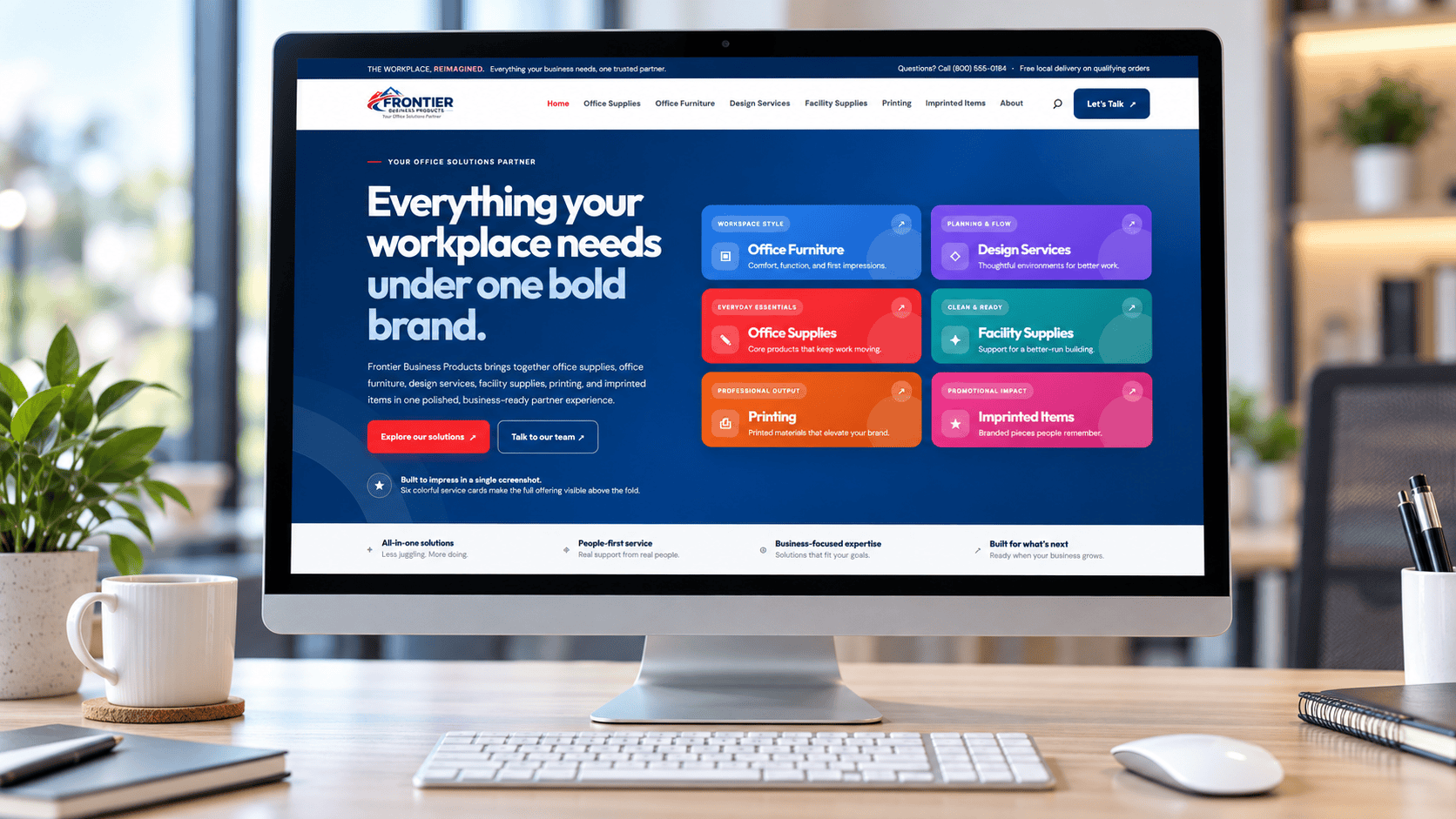

Why Independent Dealers Need a Marketing Website — Not Just Online Ordering
For many independent office products and workplace-supply dealers, the company website has gradually become little more than a doorway to the online ordering system.
That may work well for an existing customer who already knows your company, already has an account, and simply needs to order toner, paper, cleaning supplies, or breakroom products.
But what happens when someone visits your website who doesn't already know you?
Can they quickly understand everything your company provides? Can they see why they should buy from you instead of a national chain or online marketplace? Can they learn about your furniture services, workplace solutions, local support, managed print, promotional products, janitorial supplies, or other capabilities?
If your website primarily functions as a product catalog or login page, the answer may be no.
That is why today's independent dealer needs two things working together: a strong e-commerce system for ordering and a strong marketing website for selling the value of the business.
Table of Contents
- Online Ordering and Marketing Are Two Different Jobs
- Your Website Must Work for People Who Don't Know You Yet
- Your Product Catalog Rarely Tells Your Full Story
- Independent Dealers Have Advantages Worth Talking About
- Marketing Websites Give Search Engines More to Work With
- Your Website Should Generate Leads, Not Just Orders
- Your Marketing Website and Webstore Should Work Together
- Questions to Ask About Your Current Website
- The Bottom Line
Online Ordering and Marketing Are Two Different Jobs
An e-commerce system is designed primarily to help customers find products and place orders efficiently.
That is an important job, especially for established business customers who order frequently and want speed and convenience.
A marketing website has a different purpose.
It helps a potential customer understand:
- Who your company is
- What you provide
- Who you serve
- Why your company is different
- Why someone should trust you
- What geographic area you serve
- What services exist beyond ordinary product ordering
- What the visitor should do next
Trying to make one system perform both jobs can leave important gaps.
Your webstore may be excellent at helping someone purchase copy paper. It may be much less effective at explaining why a growing company should choose you to furnish an entire new office.
Your Website Must Work for People Who Don't Know You Yet
Existing customers are only one audience for your website.
A prospective customer may arrive after searching Google, clicking a link from an email, seeing your company mentioned on social media, or receiving a referral.
That person may know very little about you.
Within a few seconds, your website should help answer basic questions such as:
- What does this company do?
- Can they help a business like mine?
- Are they local?
- What services do they provide?
- Do they appear credible and established?
- How do I contact someone?
If the visitor is immediately confronted with thousands of products, category navigation, account-login prompts, manufacturer information, or pricing, those questions may never get answered.
A strong marketing website gives that visitor context before asking them to shop.
Your Product Catalog Rarely Tells Your Full Story
One of the biggest problems we see with dealer websites is that the business itself is often far more impressive than the website makes it appear.
A dealer may provide:
- Office products and supplies
- Office furniture and space planning
- Breakroom supplies
- Janitorial and facility products
- Managed print services
- Technology products
- Promotional products
- Printing services
- Safety supplies
- Installation and delivery
- Account management
- Procurement programs
Yet the website may communicate little more than:
"Search our catalog."
That creates a serious marketing problem.
Someone looking for office furniture may never realize you sell furniture. Someone researching facility supplies may never discover your janitorial capabilities. A local business looking for a full-service workplace partner may incorrectly assume you are simply another place to buy pens and toner.
Your website needs to communicate the breadth of the business, not merely the breadth of the catalog.
Independent Dealers Have Advantages Worth Talking About
Independent dealers often compete against organizations with much larger advertising budgets.
But independents also have strengths that national competitors cannot always duplicate.
Those may include:
- Local ownership
- Personal account service
- Knowledge of the local business community
- Flexible purchasing solutions
- Local delivery
- Real people customers can reach when something goes wrong
- Long-term relationships with customers
- Specialized product and industry knowledge
Those advantages should be prominent on your website.
The website should explain why purchasing locally matters, how your company supports its community, and what customers gain from working with an independent business rather than an anonymous national provider.
If the website simply drops visitors into an ordering portal, much of that competitive advantage disappears.
Marketing Websites Give Search Engines More to Work With
A strong marketing website also creates more opportunities to be discovered through search engines.
Consider the difference between having one generic page titled "Office Supplies" and having dedicated pages for:
- Office furniture
- Business supplies
- Janitorial and facility supplies
- Breakroom supplies
- Managed print
- Promotional products
- Local delivery
Each page can explain the service in detail, answer common questions, describe your service area, include appropriate calls-to-action, and provide search engines with useful information about what your company actually does.
Blog articles, buying guides, local-business content, project examples, FAQs, and industry information can expand that visibility even further.
The goal is not simply to rank for your company name. A strong website should help people discover your company while they are searching for the products and services you provide.
Your Website Should Generate Leads, Not Just Orders
An online store is primarily built to generate transactions.
A marketing website should also generate conversations.
Someone considering a furniture project probably will not add 25 workstations to a shopping cart without talking to someone first.
A business researching managed print may want an assessment.
A company moving into a new facility may need help planning supplies, furniture, breakroom products, and equipment.
Those opportunities need a path that goes beyond "Add to Cart."
A strong dealer website should include calls-to-action such as:
- Request a quote
- Schedule a consultation
- Ask about a furniture project
- Request a workplace assessment
- Contact an account representative
- Open a business account
Those actions can turn anonymous website traffic into actual sales opportunities.
Your Marketing Website and Webstore Should Work Together
None of this means the webstore is unimportant.
Quite the opposite.
The ideal setup allows the marketing website and e-commerce system to perform the jobs each does best.
The marketing website attracts and educates visitors. It explains services, establishes credibility, showcases the business, and encourages prospects to make contact.
The webstore provides the powerful product-searching, account-pricing, shopping-cart, ordering, and account-management capabilities your customers need.
The experience should feel connected.
For example, prominent Shop Online and Customer Login options can lead directly into the ordering system. Product categories can link into appropriate catalog areas. Existing customers can reach their accounts quickly without distracting first-time visitors from learning about your business.
With modern integrations and storefront designs, these systems can also share branding, navigation concepts, colors, and visual styling so customers experience them as parts of the same company—not as two unrelated websites.
Questions to Ask About Your Current Website
Take a fresh look at your website as though you had never heard of your company before.
Ask yourself:
- Can a visitor understand what we do within a few seconds?
- Does the website show everything we sell and every service we provide?
- Does it explain why someone should choose us?
- Does it demonstrate our local presence?
- Can someone easily contact us without creating an account?
- Does the website generate quote requests and other leads?
- Do we have dedicated pages for our major product and service categories?
- Is the website useful to someone who is not already a customer?
- Does the site look current, credible, and professional?
- Does our webstore feel like part of our overall brand?
If several answers are "no," the problem may not be your e-commerce platform.
You may simply be asking an ordering system to do a marketing job it was never designed to do.
The Bottom Line
Your online ordering system is an important part of your business.
But it should not have to be your entire website.
Your company has a story to tell. You have capabilities to explain, expertise to demonstrate, relationships to build, and new customers to attract.
A modern marketing website gives you the space to do that while allowing your webstore to continue doing what it does best: helping customers place orders.
The question is not whether your customers can order from your website.
The better question is whether your website is helping create your next customer.
Could Your Dealer Website Be Doing More?
If your current website is primarily an online catalog or customer-login page, Stratus Business Solutions can help you explore what a modern dealer website could look like.
We develop marketing-focused websites and modern storefront solutions specifically around the needs of independent office products and workplace-supply dealers.
Learn more about Stratus Business Solutions or contact us to discuss your current website.